PLEASE NOTE: THIS BLOG HAS MOVED TO PACIFICSAILORS.COM

Camille is for Sale

LOCATION :: San Diego, California :: Map of Current Location :: Past Anchorages
CURRENTS :: Follow us on Facebook for daily updates and photos
Showing posts with label Drama. Show all posts

Friday, May 24, 2013

I bet you've never seen that before!


La Paz, Mexico

We're back from spending the last two weeks in the national park islands near La Paz - where there is no internet...

We snorkeled, swam, kayaked, watched wildlife and paddle-boarded.


While sitting on the beach on Isla San Francisco we saw a fish that looked like he was poking his head into the water with his tail sticking up. When we went to investigate we found that a moray eel had tried to eat a fish much larger than his head and must have choked on his meal.


manta ray
manta ray


trigger fish ceviche!


Friday, May 3, 2013

How Does One Week Turn Into Three?


La Paz, Mexico

We had planned on being in Mazatlan for one week. It took us three to get out of there and we finally made it to La Paz a couple of days ago. So what took so long?

When we arrived in Mazatlan our Yanmar had logged just over 1,000 hours; and since there is a Yanmar service center in Mazatlan we decided to have them help us with our 1,000 hour service. We believe that our engine is one of our biggest safety features and it needs to be treated with lots of TLC. So far "the beast" (our engine's serial number ends in 666) has treated us with nothing but respect in return. Knock on fiberglass.

A mechanic came by to remove our heat exchanger, fuel injectors and various other things to be serviced. Turns out we had some pitting in the heat exchanger and it would need to be sent to a machine shop to get welded. This was supposed to take a couple of days. After one entire week(!) and many inquiries of progress we were finally told that the heat exchanger won't take the weld and we would need a new part - and it would take at least 10 days to get the new part! This being Mexico there is no guarantee for that and 10 days is probably being overly confident as things tend to get held up in customs.

So rather than wait for the new heat exchanger to come to Mexico we took action. We ordered the part to be overnighted to the Yanmar dealer in Los Angeles and booked a flight for Mike to fly to LAX the very next day.

Since his trip coincided with the weekend, Mike had some spare time and was able to do some other shopping for us as well - such as Trader Joes's, REI and West Marine. Best of all, Mike's cousin Randy was headed to Cabo by van and was able to bring everything down for us (including a new battery), rather than Mike carrying it back on the plane. How about that for serendipity?!

If the machine shop had been successful we would have looked at a bill of about $700. Here are the numbers for what really happened. At least now we have a brand new part and lots of goodies from the US.

Air travel (using some air-miles): $270
Yanmar parts in LA (new heat exchanger, gaskets, misc): $1,300
Overnight shipping from east coast: $70
Rental car (three days): $85
Gas (for rental car): $46
Bill from Yanmar dealer in Mazatlan: $450
Boat moorage for two extra weeks beyond planned: $260
Total: $2,381

Of course there were other expenses like food and shopping but I'm not including those in this total. If you're interested in this month's total expenses take a look at our monthly expenses.

Our fourth crossing of the Sea of Cortez was a breeze. Literally. We even got to sail some in the south-westerly winds that appeared as forecast on our favorite weather website stormsurfing (check it out - this site has much higher resolution wind forecasts than other free weather sites).

Arriving in Bahia Balandra (10 miles from La Paz) after our crossing this was what we were greeted by: Sunrise to the east and a full moon setting to the west. Beautiful!


Sunset over the Baja peninsula

The ice-cream man in Bahia Balandra makes in-water deliveries

We're currently in a slip for just a few days to replenish food and fuel


Mission in La Paz (founded 1720, built 1861)


Goodies from the US

Thursday, April 4, 2013

More Tangled Wildlife


After nearly eight months in Banderas Bay we are finally on the move again. Hurricane season and then some personal issues kept us in a marina much longer than we had anticipated.

We just arrived in Mazatlan after a nice two night passage. Considering we could have driven here in a few hours (it's only 170 miles as the boat travels) we made pretty good time. We had mostly no wind which was a good thing as the prevailing winds this time of year are from the north (the direction we were heading of course).

We saw amazing phosphorescence, spinner dolphins, some late season whales, caught a dorado and watched lots of birds catching rides on sea turtles.

At our about half-way point we came across a disturbing sight. If you remember last July we were lucky enough to save a sea turtle trapped in some derelict fishing gear. We were in just about the same place yesterday when we once again noticed a strange tangle of debris. When we slowed to take a look there was a trapped manta ray. Unfortunately we were too late, but I find it odd to keep seeing things like this...

Manta Ray caught in derelict fishing gear

Mahi-Mahi for dinner!


Monday, February 4, 2013

Anatomy of an Overnight Passage


This is a play-by-play account of our short overnight passage from Tenacatita to Banderas Bay. It seems like blogs are always about destinations so I thought I would share real-time how we spend 30 hours at sea. This passage was a bit tricky as it involved the rounding of a cape - Cabo Corrientes at the south end of Banderas Bay. All weather forecasts suggested benign conditions and favorable winds. Here is what really happened.


All icons are clickable for more info. You can also view this map in a new window.


SATURDAY

0400 We're at anchor in Tenacatita and I can't sleep. I grab a headlamp and start reading my book. Mike wakes up 10 minutes later and is wide awake as well. We had planned on weighing anchor around sunrise (0730) but since we we're both up we decide to get going now. We run lifelines, get out our harnesses and tethers, and make sure everything is secured and ready to go.

While underway we are always tethered to the boat. We use harnesses because they are more comfortable than life jackets and we feel it is safer to be attached to the boat if someone goes over than to float away in a life jacket - especially when only one of us is on deck. When the weather gets nasty we wear life jackets with an integrated harness.

0530 The anchor has been weighed and we're making our way out of the anchorage. Luckily there is a bright quarter moon because some boats didn't turn on their anchor lights and others simply use little solar powered garden lights or a string of christmas lights. The boats who do have proper anchor lights are easy to spot because their lights cast a long beam of light across the water. If you have ever considered using anything other than a regulation anchor light please try leaving a crowded anchorage in the dark first.

0630 I go back to bed to a windless morning and the droning of the engine.

1030 I wake up with a slight case of mal de mer after our week at anchor. I put on my harness and relieve Mike who is ready to get some more sleep. I have a light breakfast of a hardboiled egg, avocado and water. We're heading north, nearly straight into waves which are on top of a long swell. They are steep and short and Camille is pitching and heaving uncomfortably. I feel better now that I've gotten some fresh air and can see the waves coming. It's a clear blue sky and just over 80 degrees Fahrenheit. Wish I could go for a swim...

1045 I settle into my favorite chair on the landing above the companion way. Out of the sun and wind and with a 360 degree view it's a great place to sit out a watch. The autopilot is steering the boat and all I have to do is confirm we are still on course using the same iPad I'm using to take these notes as well as keep our boat log. Every few minutes I confirm we won't be colliding with anything and every couple of hours check the bilge and engine.


The watch seat


1130 I spot what appears to be a panga (small open fishing boats the locals use). As we get closer I start to notice a long string of evenly spaced soda-bottle-floats right in our path. I slow down to figure out where I could pass when the panga speeds over. The fishermen pick up one of the soda bottles to retrieve their lure and then motion for me to pass through the opening they have created in their mile long "fence". I thank them and continue on my way.

1320 In a steep wave right in front of the boat I suddenly see something floating just below the surface. It's a small group of manta rays gliding along peacefully until they notice the boat coming at them and dive off in a panic at the last second.

1340 Mike gets up and starts cooking lunch. Half way through cooking we run out of propane and have to switch to our other tank.

1500 Lunch/early dinner time. While we eat our cabbage and potatoes (we're a bit low on fresh food) a large pod of dolphins surrounds our boat. They are hunting for their dinner and we hope that whatever they are chasing will hit our lure to make our next meal a bit more exciting. We're making 2 knots over our usual cruising speed due to some unusual current - everything we've read says we should have a counter current here - though we're not complaining.

1330 40 miles to go to the cape and the seas seem to be settling. A nice onshore breeze has picked up. We get ready to hoist the main.

1345 Sailing!

1500 Whale off the starboard bow!


Whale


1515 We've slowed to 2 knots and decided to take in all sail. A little sad the sailing is over but we hope this means an easy rounding of the cape.

1530 As we clear the last of the lines the wind suddenly picks up to 15-20. On the nose!

1540 Motoring into wind and seas. Hoping the wind models are correct and that this wind will die out by sundown. When rounding a cape winds and seas can double in strength near the cape - called a cape effect.

1600 Fish on! Another skipjack... Mike had already caught one in the morning and made ceviche so we let this poor fellow go.

1800 Mike goes to bed. Usually he goes to bed after sundown to rest up for his watch but we both want to be awake for the rounding of the cape. My normal watch starts after sundown and lasts for six hours. Mike stands the next six hours until sunup. After that there is no real schedule but we each take a nap sometime during the day.

1835 Short steep waves are building and we're starting to get a little bit of spray over the bow. I'm debating zipping up the dodger but I like the breeze - it's still pretty warm. A balmy 82 degrees.

1900 Sunset. I turn on nav lights, zip up the dodger and put on a light sweatshirt. Still 80 degrees out but the wind is a bit chilly. The wind, waves and current have slowed us to 3 knots.


Sunset from the watch seat


1945 25 miles to the cape. We are occasionally falling off a crest and slamming into the trough - a sound I despise. I'm still hoping the wind models were correct and that this will abate to a light (southerly) breeze shortly. Also hoping that the earlier push from the current was due to a rising tide as we are now at slack tide and about to go back up.

2000 It's pitch black out now and the moon isn't scheduled to appear until midnight. The wind is still picking up and we're taking water over the bow when we fall off a crest.

2030 The weather is getting worse. After a particularly hard slam I slow the boat to 2 knots. Mike is up on deck as well now.

2145 Surrounded by cresting waves - the big ones sound like a freight train going under the boat. Whenever a particularly big one rolls under us we try to slow the boat to keep from slamming. We've discussed turning back but have decided to give it a couple more hours to see if the wind lets up.* We're now hand steering because the autopilot can't correct at these slow speeds and high winds.

2245 18 miles to the cape. The wind seems to be laying down a bit - there are a lot less cresting waves and we're able to go a little faster. Making nearly 3 knots - unless we slam into a wave which stops us dead in our track. Mike went back to bed and the autopilot is back at work. 

SUNDAY
1230 Mikes starts his watch and I get to go to bed.

0500 While I haven't been sleeping well per se, I am now very awake because the motion of the boat has changed. I get up to investigate. We are at the cape (standing 5 miles off) and rounding into Banderas Bay! Instead of pitching we are now rolling. I go back to bed for a little more rest.

0630 In the protection of the bay the seas have settled. I was just starting to get some good sleep when Mike wakes me up to take over.

0730 It's light out and I'm just waiting for the sun to rise over the Sierra Madre mountains so I can take off this jacket and open up the dodger (note that I've been barefoot and wearing shorts all night - it never really got below 76)

0750 Sunrise. A welcome sight after a long night.


Sunrise


0800 Everywhere I look there are fish jumping. I toss over the hand-line in hopes of catching something for lunch.

0830 15 miles to go across the bay to Punta de Mita where we will anchor for tonight. Tomorrow we will do the last 15 miles back to Paradise Village Marina (Mike's parents are flying in Tuesday).

0930 Dolphins are doing acrobatics just off the bow. They are rather small so I'm guessing they are spinner dolphins.

1030 Bottle nose dolphins are following us off the quarter. I have read that Banderas Bay is a nursery for dolphins - there were a lot of babies in this pod.


Dolphins in Banderas Bay


1130 Whales, whales, whales. Everywhere we look are spouts and pangas full of tourists following the whales. We even see a few of them breach. These last few hours made us forget all about our not so fun night and reading back over my notes I think "Was it really as bad as it sounds?"


1230 Anchor down in Punta de Mita. Mike is the first one in the water. 


1400 Tacos on the beach


1730 Pina Coladas in our cockpit


* At no point were we in any danger. It was just a very uncomfortable ride and the wear and tear on the boat more than we like.

Thursday, October 11, 2012

Fear


A couple weeks into our 21-day Atlantic crossing from the Canary Islands to Barbados we were sailing along nicely while I was fast asleep in my bunk. It was that magic time when things always seem to go wrong - around 2am. I was awoken by a loud thud and a strong jerk which felt like the boat had come to a sudden stop. It was all hands on deck. The boat had indeed stopped moving, though the sails were still full and trying hard to pull the boat. 

Had we run aground in the middle of the Atlantic? We checked the bilge for any intrusion of water and after finding a slow trickle we grabbed some flashlights and checked around the boat. And there they were: faded yellow buoys attached to an old fishing net surrounding our boat. We pulled up on the net and started cutting it back but it just kept going and going like one of those magic handkerchiefs. In the beam of the flashlight we could see a thick line leading down into the deep dark sea. We later learned the net had been hung up on the propeller and broken our strut in half. 


After having seen but one boat in the past two weeks my mom suddenly saw a light on the horizon. We called them on the VHF and they responded immediately. We told them of our troubles and they offered to help. When they pulled up next to us we were looking at a 55 meter (180 feet) luxury yacht - the Lady Ghislane of London - then owned by British billionaire and member of parliament Robert Maxwell. 


They offered to have their divers cut us loose in the morning but until then they did not want to waste time by waiting around. They tossed us a line and proceeded to tow us through the rest of the night at 10-15 knots! We had never seen those kind of speeds on our boat and it was not without some damage.  We had a few bent stanchions and nearly ripped the cleats out of the deck before we attached the tow line to the mast. 


Our wake while being towed


At first light their divers cut away the net and line.* We had a slow leak the rest of the crossing and in Barbados hauled the boat to make repairs. Since we were participants in the ARC (Atlantic Rally for Cruisers) our story was written up in the 1994 edition of Jimmy Cornell's book "World Cruising Handbook".


This event took place in 1987 when I was 14 and cruising with my parents. I recall not being scared at all. On the contrary. Something was finally going on! After two weeks at sea it was a welcome relief from the routine. 

How would I react to something like this happening today? Panic comes to mind. Being over a thousand miles from land without a GPS-enabled EPIRB (GPS didn't exist back then) trapped in a piece of rope attached to an unknown item in the abyss and unable to move forward is not a favorable situation. 

In the years leading up to our current cruising adventures I still had that same fearless attitude and didn't think I would be scared venturing far offshore on our own boat. Boy was I wrong. Something about growing up and learning about everything that could go wrong has made me a lot more fearful of the sea and traveling by boat. 

The good thing about no longer being fearless is that I now think (obsess?) about everything that could go wrong and try to plan accordingly. Working as hydrographers, Mike and I were lucky to have had our share of safety courses and monthly drills where we learned how to deal with most major emergencies.

The next time you find yourself sitting in your cockpit while underway, look around. What is the first thing you would do if someone fell overboard that instant? Or one of the shrouds failed? Or a battery overheated and started smoldering? Are you ready for Murphy to take over your boat?

* We asked the crew of the Lady Ghislane how we could pay them for their efforts. They declined and instead asked us to make a donation to the UK volunteer maritime search and rescue organizations, which my parents did after we arrived in the US. 
The owner of the yacht tragically fell off his lovely ship a few years after our chance meeting.


This post was written as part of a blog-hop. Visit the Monkey's Fist website for posts about this topic written by other cruisers or check out these topics:  

Why do we Cruise
Relationships Aboard
Pink and Blue Jobs Aboard
Leave it or Bring it: Stuff
Provisioning
Swag and Approaching the Natives
Clothes and Laundry

Thursday, July 26, 2012

Beware ATM Fees in Mexico


In order to pay our rigger in La Cruz we had to get cash from an ATM machine located at the marina - a US dollar only dispensing cash machine. We normally only take cash out of ATM machines located within an actual bank building but La Cruz is a small fishing town without a bank.

Our bank refunds all fees so I was not worried when I saw there would be a 45 peso fee (about US$3.50). The ATM also stated that the exchange rate would be 14.75 pesos to the dollar. This is where I should have paid more attention!

My US$400 withdraw ended up showing up as US$465 at our bank!

How did this happen you ask? After many emails with the ATM company they finally explained to me that rather than taking $400 from my bank directly, they first converted the $400 I withdrew into pesos at their rate of 14.75 which makes 5,900 Pesos plus the 45 peso fee. This total amount is sent to my bank which converts back to dollars at their rate. This rate varies with the market but was around 12.70 at the time.  So Cashola made a $65 profit on my $400 withdraw!

The owners of the ATM machine (a big chain here in Mexico) has offered to send me a refund check for US$25. I also received a $10 fee refund from my bank but I'm still paying $30 for this transaction. So now we only withdraw pesos and certainly don't use the US $ dispensing machines. 

Monday, July 16, 2012

Sea Turtle Rescue


This is the (true) story of how a dorado saved the life of a sea turtle....

>>Be sure to watch the video at the end<<


After an early morning start from Mazatlan, we headed for Puerto Vallarta. Mike was napping below and I was whiling away the time of my watch with a good book in our sunny cockpit. There wasn't much of a breeze and just a few clouds. Being "on watch" simply means we look around every ten minutes or so, making sure we are still on course and no other vessels are in sight. Occasionally we also check the fishing line that always trails our boat. Most times it seems to repulse any fish in the area but not this morning! I yelled down to Mike that we had a fish on the line, slowed the boat and started reeling it in. When I saw a bright yellow flash I knew right away it was a dorado. We'd be eating good tonight! As soon as Mike heard me say "dorado" he was up on deck with the camera, ready to document the occasion. As I got the beautiful fish close to the boat Mike took a couple of photos and then the fish had one big burst of energy and shook himself free of the hook. So much for fresh ceviche and fish tacos....


While we were lamenting our loss, I spotted something white floating not far off the port side of the boat. We usually don't go out of our way to investigate trash for fear of getting line or netting, that may be attached to it, into our prop. But this thing looked odd to me,  it appeared that something was swimming very close to white flotsam. I took the boat off autopilot and steered over to it. Mike went up on deck to spot any debris that might foul our prop.

As we approached, it became clear that the white flotsam I had spotted was a makeshift buoy made out of a white plastic jug and a 2 liter soda bottle. And tangled up in it appeared to be a sea turtle! At first glance we thought the turtle was dead because we saw what looked like white bugged out eyes, but as we approached the turtle started to thrash around. We later discovered what looked like white eyes on top of the turtle's head were actually two white barnacles attached just above each of the turtle's eyes.


Now that we knew the turtle was still alive we had to try and rescue it.  We formulated a quick plan and pulled some gear together. As we approached the buoy again, we noticed a line trailing down that probably had a shrimp or lobster pot at the end of it. We also noted which direction the current was pulling it and made sure to make subsequent approaches from the opposite side to keep our prop clear. While I pulled up to the buoy Mike was on the bow trying to toss a loop of line over the jug.

The current, swell and waves kept pushing us off target and after several tries we decided to try backing up to it so Mike could use our swim-step and be closer to the water. Every time we approached, the poor turtle started to panic and tried to dive, but with the buoy attached to one flipper it could barely dive a foot deep. After several tries Mike was able to grab a hold of a short line attached to the buoy and get our rope around the jug so he could pull the turtle close to the boat and remove the buoy from the turtle.


With the whole contraption firmly attached to our boat we were taking a short breather when we realized that now the turtle was being pulled under water and no longer able to come up for air. So Mike just started pulling the whole thing toward the boat and cut the line that was dragging everything down. But the turtle was still attached to the white jug. Mike pulled it onto our swim step and once the turtle was on deck he cut away the line that was wrapped tightly around the turtle's flipper. After letting the turtle rest a while Mike pushed it back into the water and it dove off in a flash. Viva la vida!

So you see, if it hadn't been for the dorado that made us slow the boat down, I probably would have missed the white buoy all together because I wasn't due for a look around for another ten minutes. And if the dorado hadn't gotten off the hook we would have been too busy dealing with it to spot the buoy.

And that is how the dorado came to save the sea turtle!

In hindsight, we wondered if we could have done things differently. There was a 3’ to 4’ swell, the current was running at about 2 knots and we were over 20 miles from shore. There were just the two of us on the boat. We later emailed with a marine conservationist and were told that the best way to approach a distressed marine mammal is for the rescuer to be in the water. We had considered this as we formulated a plan for the rescue and we were just not comfortable with going into the water. Considering the sea state and the risk to ourselves and our boat we still believe that we made the right decisions.

>>If you would like to see our updates on FaceBook, "Like" our FaceBook page to keep in touch<<

Thursday, April 19, 2012

Between a Rock and a Hard Place


Icons on map are clickable for more information on anchorages, marinas, snorkel spots, etc. Zoom out for others.


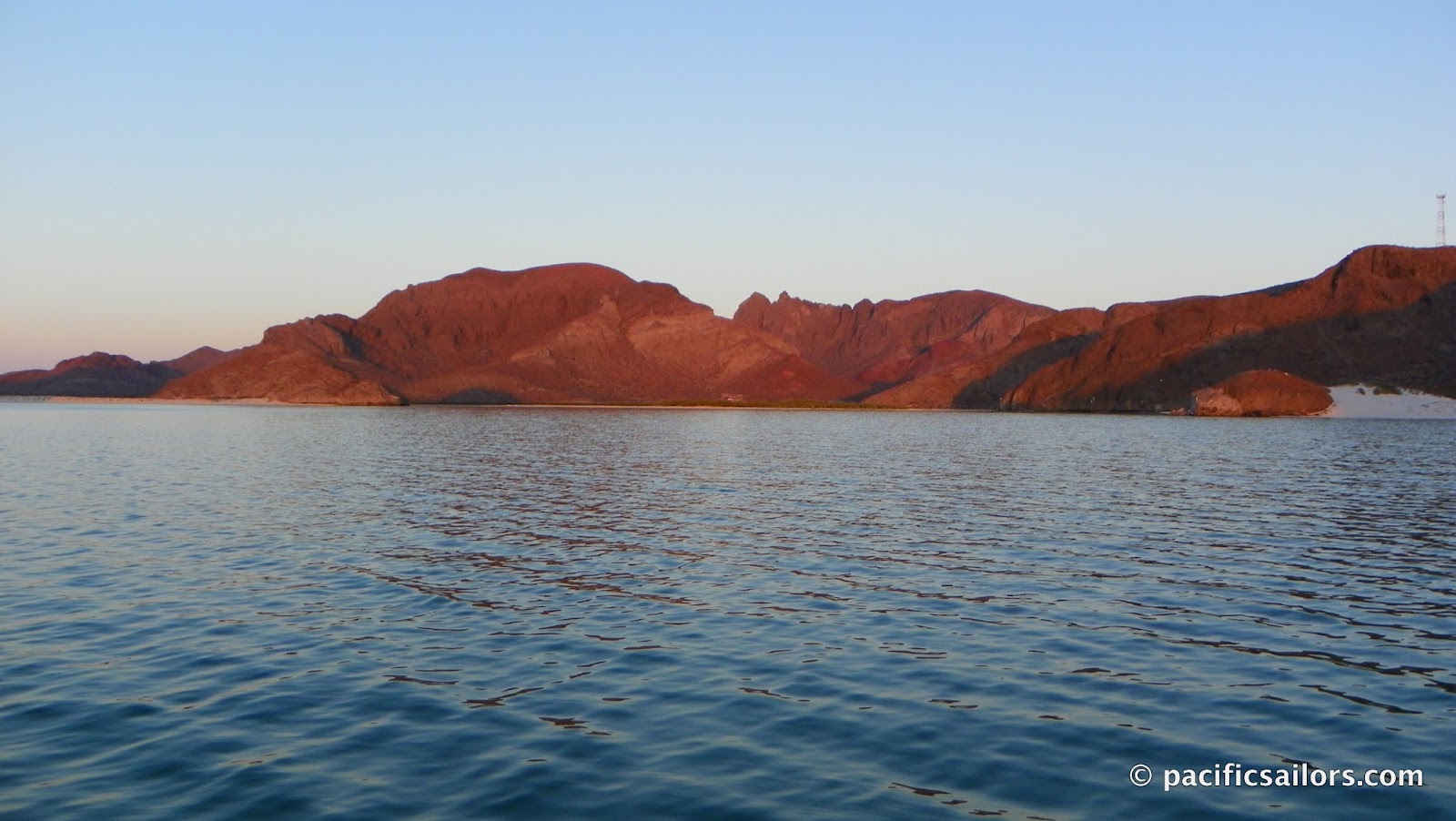
When we arrived in Bahia Puerto Balandra around 5pm we were stunned by how beautiful the bay was, with rugged cliffs and small coves of white sand beaches. We set our anchor as usual, in 12 feet of water at low tide, and paid out 75 feet of chain. After making sure that it was set well, we jumped into the emerald green water with our snorkel gear. Mike swam over to our anchor (a Manson Supreme - the name alone helped me sleep... until now) and made sure it was nice and buried in the sand.

Snorkel reef

After snorkeling and quick showers on deck, we had dinner and a sundowner. During dinner the wind started to pipe up a bit. We weren't too surprised as it had been forecast to blow about 15 - though we haven't had any wind at night time for weeks. 

Before heading to bed we did our usual evening checks and made sure the deck was clear of obstructions. Every night we put the spotlight in the companion way to grab if needed. Of course we didn't think we would need any of it since we had been through much heavier winds.

Fast forward to shortly before midnight. I woke up to wind howling in the rigging. I nudged Mike to get up and check on things (I like to use the I'm not wearing my contacts excuse). He begrudgingly rose and headed up top. Not long after he came back down and said "I think we've drug anchor". I grabbed my glasses and threw on a jacket (it's been getting down to 60 at night). I started turning on instruments and deck lights while Mike started the engine. We had dragged almost a quarter of a mile and were now very close to a rock cliff on the other side of the bay with the wind blowing us toward shore. Luckily, the anchor appeared to be holding. 

We didn't feel very comfortable next to the cliff but it was dark and there are a couple of small reefs in the bay making maneuvering difficult. We decided to hoist the anchor anyway and follow our trackline back to our original position. While Mike was up on the bow running the windlass I was praying that the engine would not fail as soon as the anchor came up since we would have been blown onto the cliff in mere seconds. 

With the anchor up I started heading into the wind along our track line towards our old anchor spot. Mike came back to grab the boat hook and told me that a big rock had lodged itself into our anchor!!!  Well that explains it!

With our anchor once again ready for service we dropped the hook as usual and went back inside to listen to the wind howl and the boat creak and groan. But not before turning on the anchor and depth alarms and staring incessantly at our GPS position on the iPad...

Lessons learned

  • Just because your anchor has held out through 40+ knots of wind before doesn't mean it will do so again.
  • Check if lone rock wedged itself into set anchor in an otherwise all sand bottom. 
  • Turn on anchor and depth alarms!
UPDATE (May 23, 2012): After this debacle we tried to use the iPhone/iPad as an anchor alarm. The problem is that it has to be left on (screen lit) all night and connected to power. It also seems to shut itself down after some hours which turns off the anchor alarm. I'm not a fan of having to run out into the cockpit every time we get a false alarm on the chartplotter so we now use our handheld GPS with anchor alarm. We record our track and set the audible alarm. Works great and  there is no need to get out of bed!

The rock cliff